
Does My Child Need a Social Skills Group or Individual Therapy?
Quick answer: If your child or tween mainly struggles with knowing how to interact with peers (joining play, reading social cues, taking turns) a social skills group is usually the better fit. If your child avoids social situations because of anxiety, low self-esteem, or a difficult experience like bullying, individual therapy is usually the better place to start. Many children benefit from both.
If you're a parent trying to figure out whether your child needs a social skills group or individual therapy, you're not alone—it's one of the most common questions families bring to us at Collaborative Minds. Below, we'll walk through what each option actually looks like, the signs that point to one over the other, and how to talk to a therapist about finding the right starting point for your child.
What Is a Social Skills Group for Kids?
A social skills group is a small group therapy format where members, who are usually matched by age and developmental level, meet with a therapist to practice real social interaction in a structured, supportive setting. The therapist guides the session, but the real work happens between the group members— that's what makes it effective.
A social skills group may be the right fit if your child:
Struggles to make or keep friends
Has trouble joining a group of kids who are already playing
Misses social cues like tone of voice, facial expressions, or personal space
Wants friendships but doesn't know how to build them
Understands social rules "on paper" but has trouble using them in real time
Needs practice with turn-taking, sharing, or handling losing and disagreements
The advantage of a group is that it's a low-stakes rehearsal space with real peers. A therapist can explain how to join a conversation, but a child learns it by actually trying and getting to try again the following week.
What Does Individual Therapy Look Like for Children?
Individual therapy is one-on-one time between your adolescent and a therapist. It goes beneath the behavior to address what's driving it, which makes it the better starting point for many adolescents before group work begins.
Individual therapy may be the right fit if your child:
Feels anxious, embarrassed, or shut down in social situations
Is processing a specific event, such as bullying, a friendship breakup, or a family change
Needs to build emotional regulation skills before joining a group setting
Has co-occurring concerns like anxiety, depression, or sensory sensitivities that need individualized attention
Isn't yet comfortable being vulnerable or trying new behaviors in front of other kids
Individual therapy moves at your child's pace and builds the trust and confidence they may need before they're ready to practice skills alongside peers.
Social Skills Group vs. Individual Therapy: How to Tell the Difference
Here's a simple way to sort it out:
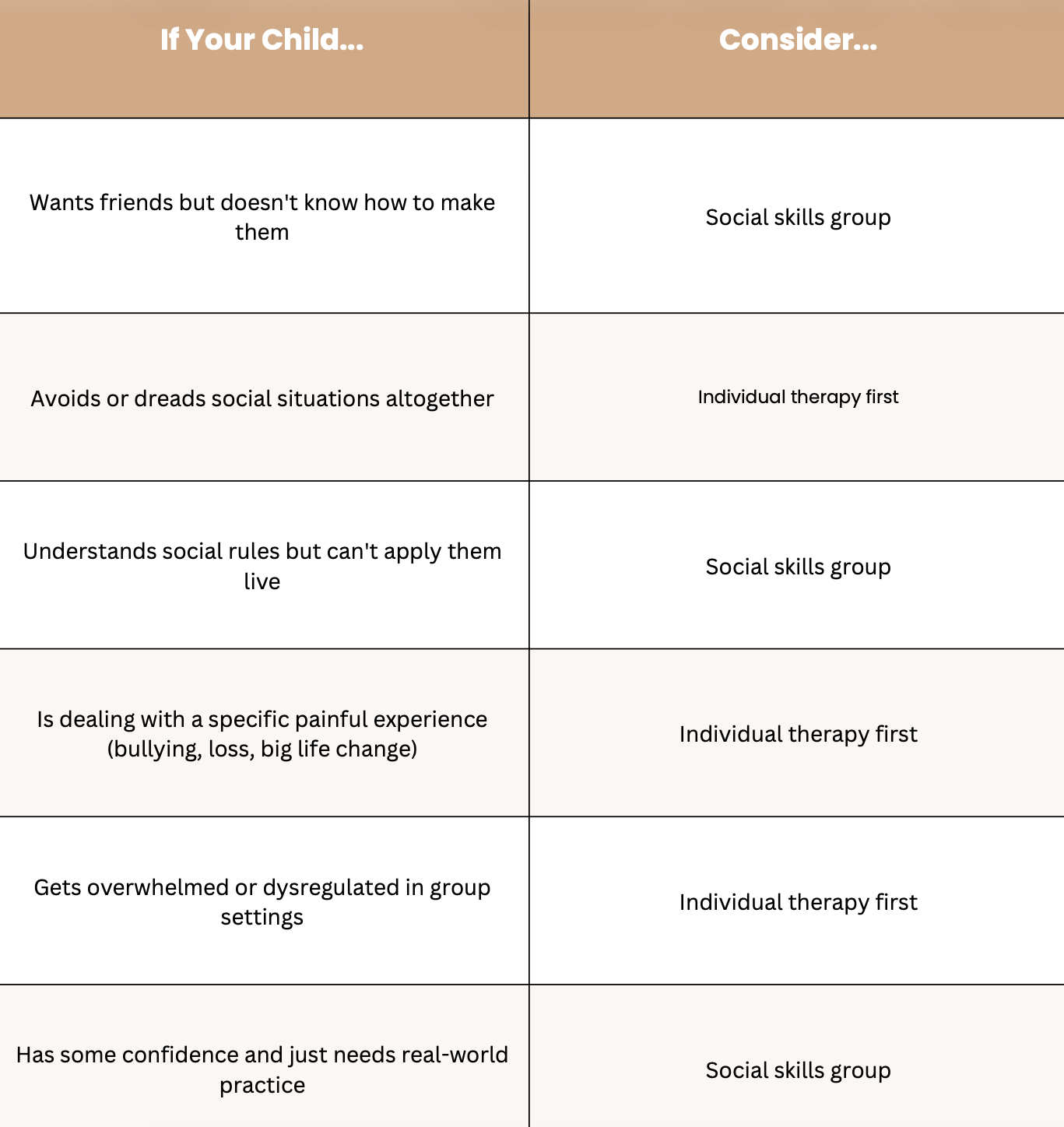
For a lot of kids, it isn't strictly one or the other, it's a matter of order. A common and effective path looks like this:
Start with individual therapy to build coping skills, work through anxiety, and understand what's really driving the social struggle.
Move into a social skills group once your child has more tools and confidence, to practice those skills with peers in real time.
Continue individual sessions alongside the group if needed, to process how it's going and reinforce progress.
More Considerations About Adolescent Therapy Options to Keep in Mind
Is the issue "I don't know how" or "I'm too anxious to try"? Not-knowing tends to respond well to group practice. Anxiety or avoidance usually needs individual work first.
Does my child already want connection and just need practice? Groups tend to work best for kids who want friendships but lack the tools.
Is there a bigger emotional issue underneath the social struggle? If so, individual therapy is usually the better entry point.
How does my child typically respond to group settings? A child who shuts down or becomes overwhelmed in groups may need individual support first.
Frequently Asked Questions About Individual and Group Therapy for Kids, Tweens and Teens
How do I know if my child needs a social skills group? Signs include difficulty making or keeping friends, trouble reading social cues, and understanding social rules without being able to apply them in real situations. A social skills group gives kids a structured, supportive space to practice those skills with peers.
Can a child do both individual therapy and a social skills group at the same time? Yes. Many children start with individual therapy to build confidence and coping skills, then add a social skills group once they're ready to practice with peers. Some children benefit from doing both at once.
What age is best for a social skills group? Groups are typically organized by developmental stage rather than age alone, and most practices, including ours, offer groups spanning early childhood through the teen years. A clinician can help match your child to the right group.
Is individual therapy or group therapy better for social anxiety? Individual therapy is usually the better starting point for social anxiety, since it addresses the underlying fear and builds coping skills before your child is asked to interact in a group setting.
The Best Next Step: Talk to a Professional
These guidelines can help you narrow things down, but every child is different, and the clearest picture comes from an evaluation with a clinician who can observe your child directly, talk with you about your concerns, and, when helpful, consult with teachers or other caregivers.
If you're not sure whether your child needs a social skills group, individual therapy, or both, we're happy to help you figure it out. Reach out to Collaborative Minds to schedule a consultation, and we'll work with you to build the right plan for your child.